Fluorescence in Minerals
One of my interests is geology, so it is no surprise that I like exploring caves.  Certain minerals, when exposed to black light (ultraviolet light) will fluoresce.  Calcite, a mineral basic to the formation of stalagmites and stalactites in caves, fluoresces.  And so does uranium glass (I know this thanks to the gift of an antique glass creamer to my wife).

In July 2004, before my first trip to Mammoth Caves, I built a black light source based around a fluorescent tube.  The performance was less than ideal.  It did not give off enough light and it was a battery hog.  Then I discovered cheap and readily available LEDs (light-emitting diodes) that emit light in the near UV range!  While the emissions around 395 nm are only low in the UVA range, they do cause a number of substances to fluoresce (including calcite and uranium glass).  So I bought a few for a test, and the results were better than with what I was getting with the tube.

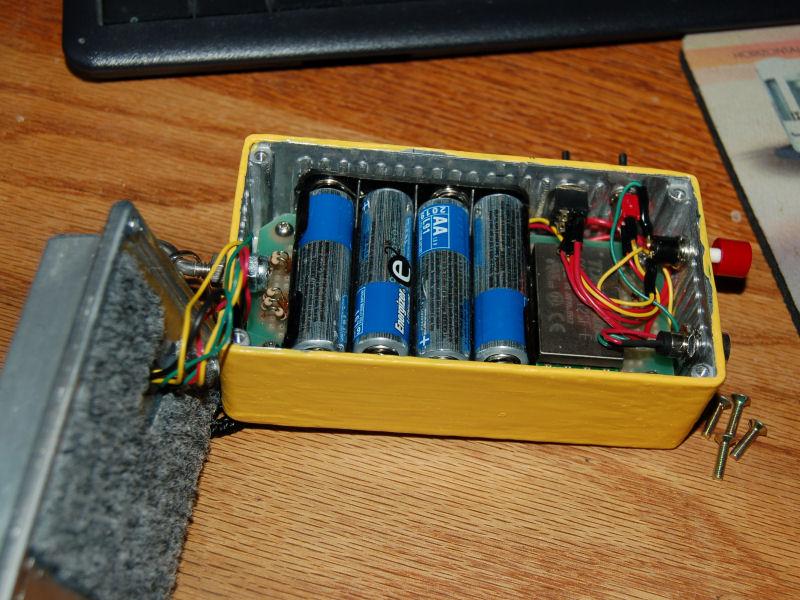
My prototype is based around the same DC-DC converter that I used with Flasher, and three UV LEDs.  This worked much better, although the light output could be better (the chrome bezel LED holders were blocking some of the light also- only the tip of each LED is exposed).  So, I obtained more LEDs, first deciding on six, then nine, finally reaching a grand total of 18.  That's a whopping 200 mW or more of UV.  But now I encountered another problem- I noticed the DC-DC converter was getting painfully hot (and this was with 15 LEDs).  While the manufacturer of the chip says that the chip is rated for the power drawn, I really don't like anything to run that hot.  So, I replaced the DC-DC converter circuit with a ready-made one to reduce power dissipation (through I²R losses).  Also, when I looked over the specifications of the inverter (powering the fluorescent tube), the LED / DC-DC converter version not only puts out more light, but it uses less power than its predecessor.

This page was last updated on: March 16, 2011
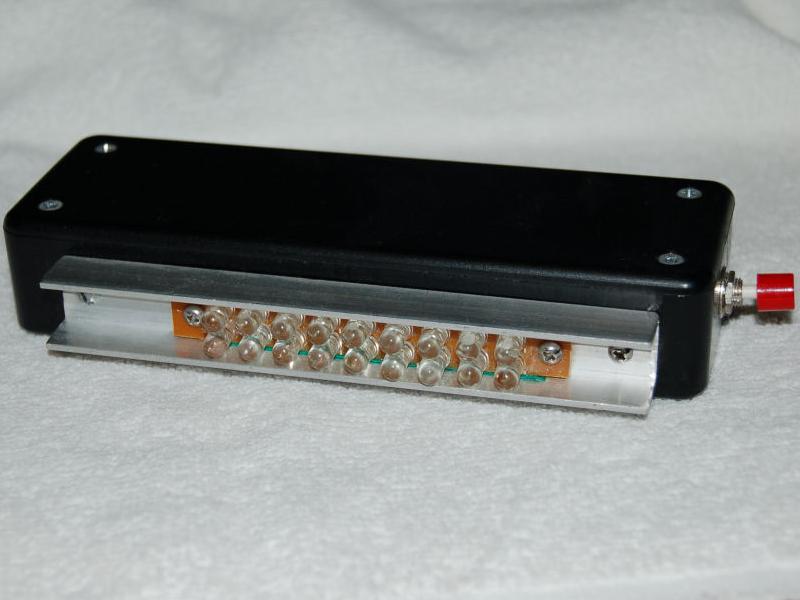
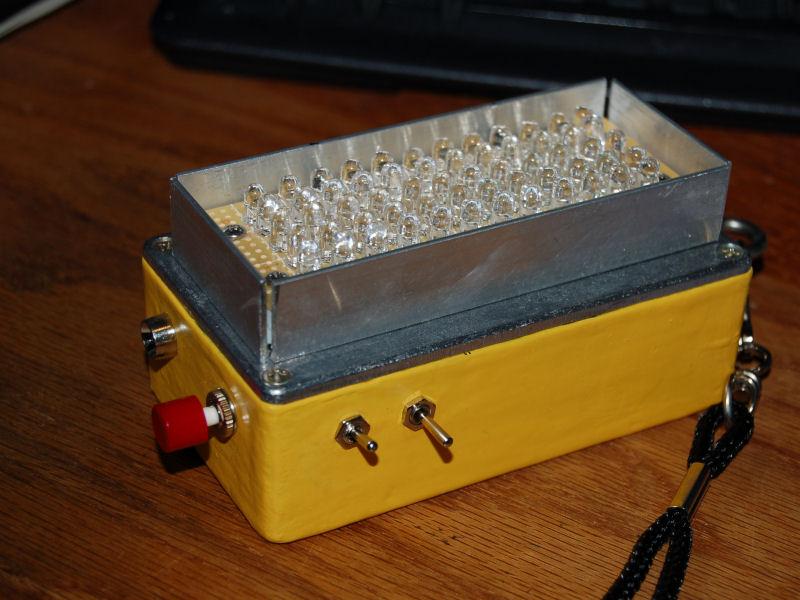
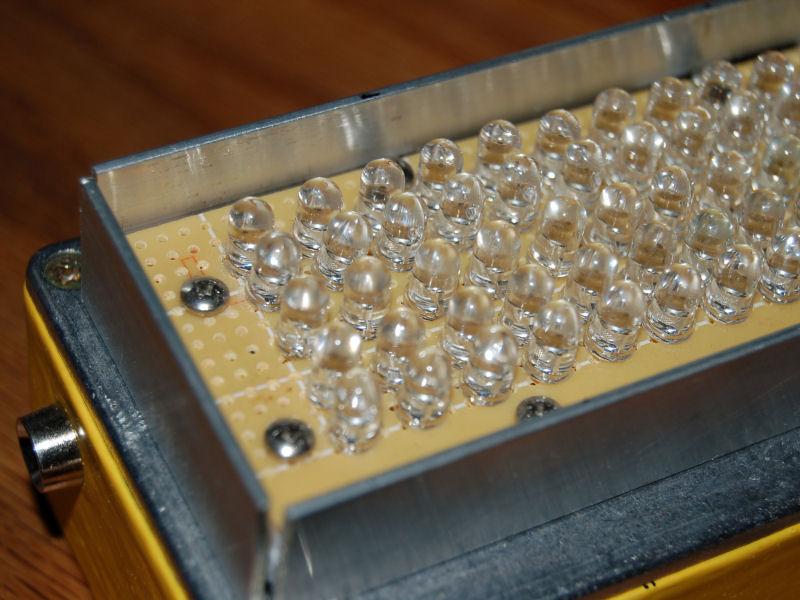
Never satisfied with enough UV, in the summer of 2010, I eventually built a 60 LED monster.  It can be switched between 36 and 60 LEDs.  Four lithium batteries provide power to a DC-DC converter (to maximize battery life and keep light output constant), which steps up the voltage to 12 V.  After that, the LEDs are wired as five groups of twelve- each wired through an 11 ohm resistor.  Each group of twelve (4 X 3) is four parallel-wired groups of three LEDs wired in series.  This wiring configuration had an unexpected problem- some of the LED strings would occasionally flicker.  Since all diodes (LEDs included) have a fixed voltage drop across them, and for even identical types of LEDs that there is slight variation, some of the series groups have a total voltage drop higher or lower than the others.  And as a result, ones with the lower voltage are acting as voltage limiters (i.e. as a Zener diode) on those groups with higher voltage drops.  Were I to start again, I could match diodes to minimize this.  But that's a little hard now.  What I will do is break up the groups of four into groups of two (2 X 3) with each a 22 ohm resistor.  That should fix this nuisance.

Anyhow, this 60 LED illuminator worked too well.  I'm not sure now how much of what I see is the visible light also emitted, and how much is fluorescence.  So, I started work on a true black light illuminator.  My first idea was to use an optical filter to limit light above 400 nm.  Also, there are quite a few minerals that will not fluoresce or do so poorly under the longwave black light of 395 nm.  So, I am also working on prototype illuminator, using a switchable combination of 355nm, 365nm 375nm and 395 nm LEDs.  The output will be filtered by a UV bandpass filter (U-330) from Edmund Optics to pass only light below 400nm.  I ordered the first three LEDs from a company in Austria (Roithner LaserTechnik).  And now I find myself being threatened by the FDA!  For the life of me, I don't know yet why the Food Nazis care about my electronics project.  But if they think they can take my LEDs, well, to borrow a quote from the legendary Charlton Heston, "From my cold, dead hands".

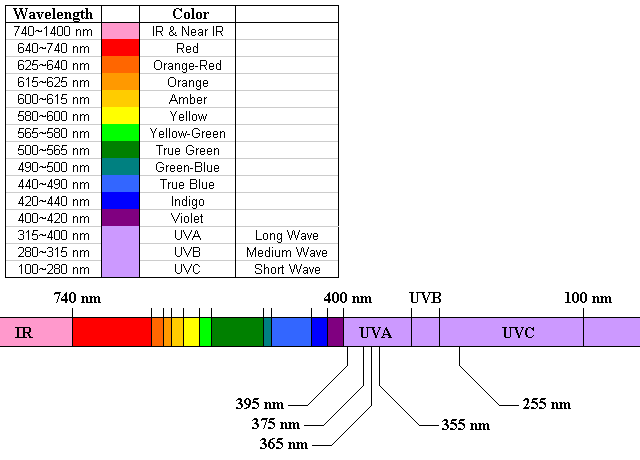
Also, I have just found a relatively cheaper source of 255 nm LEDs for shortwave black light.  Horribly expensive (the battle in my budget rages on!), but they will give me shortwave UVC light to fluoresce things that won't under longwave 395nm UV LEDs.  The chart below illustrates several issues.  395 nm is so close to the visible spectrum.  Even state-of-the-art 255 nm LEDs are on the low end of shortwave black light.  Still, 200 nm will be the high end, no matter what technology comes up with- that is where oxygen begins to significantly absorb UV (the beginning of so-called "vacuum UV").
The 60 LED monster!
My first tests with the new LEDs were a mixed bag.  I saw no advantage of using the 355 nm or 365 nm LEDs.  Granted, my collection of rocks that fluoresce is very small.  But the light output goes down rapidly with the shorter wavelengths.  For example, my 395 nm LEDs supposedly put out 12 mW of light, and the 375 nm LEDs, around 6.8 mW.  But for the 355 nm and 365 nm LEDs, just around 1 mW.  Unless I can find minerals that glow under 355 nm and 365 nm and won't under 375 nm or 395 nm, my next prototype will use those LEDs ONLY.

Which brings me to the next issue.  All of the LEDs, in addition to the UV light, also give off visible light of sufficient brightness to wash out most fluorescence.  I tested all of the LEDs with a U-330 filter, and the visible light was dramatically reduced.  Now this filter did also cut down the desired UV light; I'll just have to make it up with quantity.  The 395 nm LED was affected the most (although I could not see any visible reduction in fluorescence with my test object).  The specs for the U-330 that I downloaded from Hoya Optics say that transmission for 395 nm is 32%, and for 375 nm is 76%.  With the filter in place, that makes the 375 nm brighter.  But these are much more expensive LEDs, so I will use a half-half mix.  The filter is also expensive, and I only have a limited number of sizes to choose from.  That makes it harder for me to put it all into a less clunky-sized box than the Monster.  I contacted Hoya to see if I could get a non-standard size, but that came with a non-standard price.  So, I may be stuck with something even bulkier (to shield the filter).

Also, I need space to house a likely 255 nm LED.  In an online exchange, the notion of using such for mineral fluorescence was discouraged as not (yet) being practical.  But I'm not ready to abandon the idea.  I found a better (read that as 'more costly') filter for 255 nm to maximize desired transmissions, and I have a idea to boost output.  While looking over higher-power assemblies (multiple LED dies in one package), I noticed that some had the option of an integrated thermoelectric cooler.  Well, now!  That's a technology that I have spent a lot of time with.  In a book (Lasers, Ray Guns & Light Cannons by Gordon McComb), a laser diode was pushed well past its ratings by supercooling it.  I have two (cheap) Nichia 375 nm LEDs in a TO-18 metal can that I can experiment with before I even DARE think about trying that with a $270 LED.  Now if this does work, there is still one downside.  The whole idea of using LEDs is to stay battery friendly and avoid fragile fluorescent tubes, mercury, etc.  Thermoelectric coolers are notorious power hogs.  Will one small enough to be effective stay battery friendly?  Stay tuned for more details.

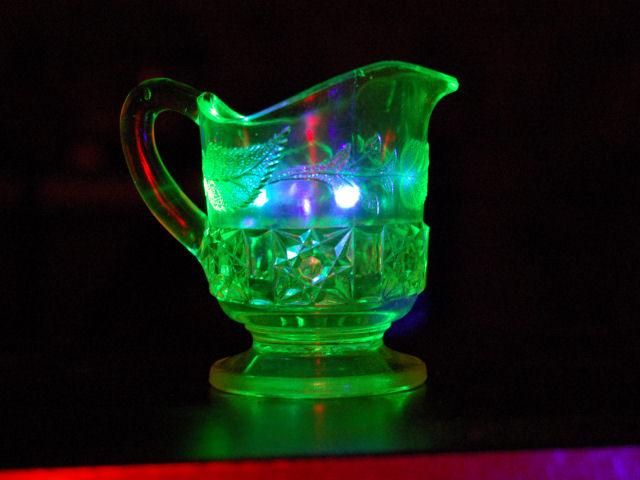
So far, all of my UV light sources are longwave.  I just purchased a shortwave UV lamp to help me identify any minerals that will fluoresce with shortwave and won't with longwave (many won't).  I also got a 405 nm laser pointer with the lamp- both from www.uvtools.com.  While technically not UV, anything that will fluoresce with longwave UV should fluoresce at 405 nm.  Below is the antique creamer made of uranium glass mentioned above.  It readily glows under any of my homebrew lamps, and just screams when illuminated by the laser pointer.
There are a number of books available for those interested in fluorescence and collecting fluorescent minerals.  See below:

The World of Fluorescent Minerals by Stuart Schneider
Collecting Fluorescent Minerals by Stuart Schneider
You can get these directly from the author.

Ultraviolet Light and Fluorescent Minerals by Thomas S. Warren, Sterling Gleason, Richard C. Bostwick and Earl R. Verbeek.