One thing that I needed was a red flashlight, to protect night vision. A company that I requested information from once gave me a cheapo flashlight. But I already owned a Maglite, so I had no need for it. Until I realized that a jumbo red LED (which I got out of a grab bag full of LEDs) fit perfectly where the light bulb went. However, when I used it out in the field, it just didn't put out enough light to be of much real use. Then I remembered seeing super-bright LEDs in a catalog. I got several from Radio Shack, tested them out on breadboard, and the results were fabulous. Rated at 3000 mcds each, lighting was no longer a problem. In fact, if you're not careful and look at these directly, you will see a camera flash-like after-image (not good for night vision).
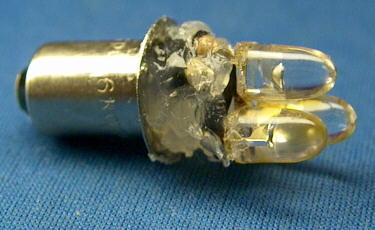
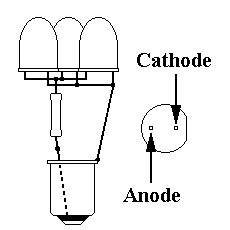
With my jumbo LED, I just soldered it directly in place; a resistor on one leg, a metal contact for the battery to the other. This time, I took a light bulb, and crushed the bulb. I cut the lead connected to the case. Now I had to determine a value for the current-limiting resistor (to keep the LED from burning out). I planned to wire three LEDs in parallel. Each LED, (RS# 276-307) is rated at 1.7 volts @ 20 mA. Since the flashlight batteries furnish 3 volts, the resistor would have to drop 1.3 volts @ 60 mA.
Using Ohm's law, Volts / Current = Resistance: 1.3 / .06 = 21.67 Ohms.
As I didn't have any small resistors close to that, I had to parallel two to get an equivalent. With some very delicate soldering, I first soldered the three LED anodes (LEDs, unlike light bulbs, are polarity sensitive. Most LEDs usually mark the cathode [negative] with a flat side.) together. Then I soldered the resistor to the anodes. I used heat-shrink tubing to avoid shorts. Next, the cathodes were soldered together, then to the metal base. I tested the lamp, and it worked. I then sealed things up with silicone rubber. All in all, not pretty, but it works.
Also, I've been experimenting with using different colors, in place of the traditional red, after reading a posting in the ATM archives. Basically, red may not be the best choice for protecting night vision (click here to see details).

 One thing that I needed was a red flashlight, to protect night vision. A company that I requested information from once gave me a cheapo flashlight. But I already owned a Maglite, so I had no need for it. Until I realized that a jumbo red LED (which I got out of a grab bag full of LEDs) fit perfectly where the light bulb went. However, when I used it out in the field, it just didn't put out enough light to be of much real use. Then I remembered seeing super-bright LEDs in a catalog. I got several from Radio Shack, tested them out on breadboard, and the results were fabulous. Rated at 3000 mcds each, lighting was no longer a problem. In fact, if you're not careful and look at these directly, you will see a camera flash-like after-image (not good for night vision).