Telescope Specifications
1.) Dobsonian
2.) Truss-type construction
3.) f/5, 17.5" main mirror, temperature controlled
4.) 3.1" secondary mirror, temperature controlled
5.) 90mm telescope as finder
6.) Crayford focuser
7.) Digital setting circles
Design Issues
 The first thing to decide was how big was big enough and affordable enough. A 17.5" mirror was both as heavy as I could reasonably lift and the most that I could afford. A recent test drive of a comparable 16" telescope at a star party confirmed that this was enough telescope for me. For now, I'm going to continue to study other ideas and designs. Unless I get access to a suitable work area (a carpeted condo isn't the best place for wood and metal work), I'll just have to wait to take it all down to my father's shop. Besides, at present, this is, as I euphemistically phrase it, an "unfunded project".
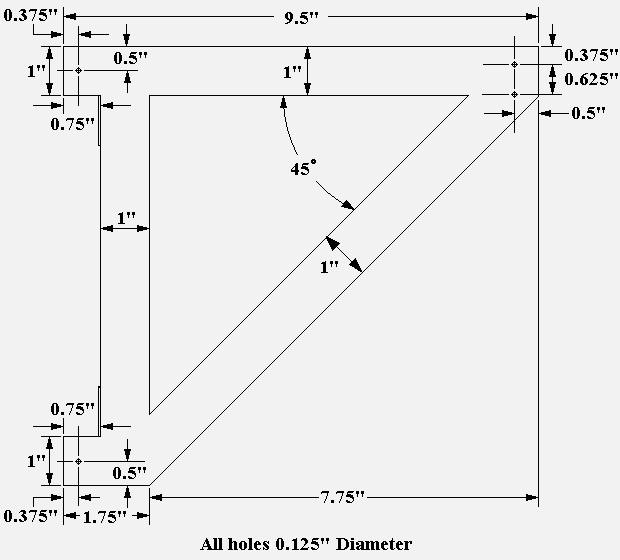
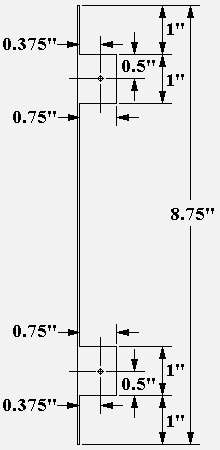
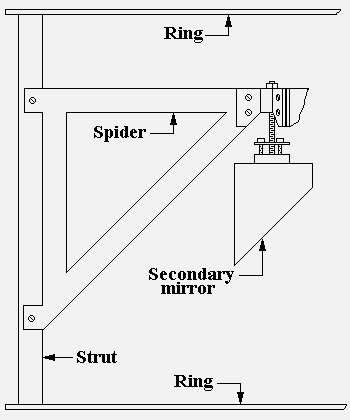
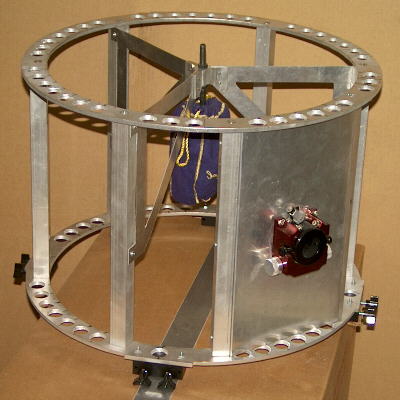
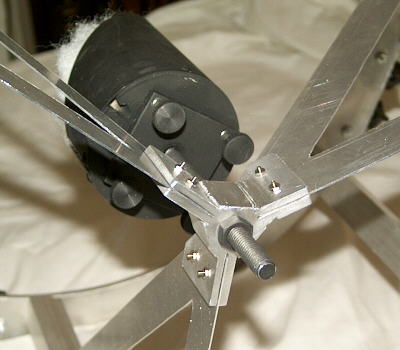
From the beginning, this scope was planned out to be a truss-type. Mirror size was largely determined by weight and cost (I will buy rather than grind the mirror- another challenge for another day). The secondary cage will be built totally out of aluminum (excluding the light shield, which will be of Kydex). After much research, I settled on a spider design utilizing three (rather than four) vanes. The choice of three vanes was to minimize diffraction spikes, and they are triangular (in effect, a truss) to give maximum support of the secondary mirror.
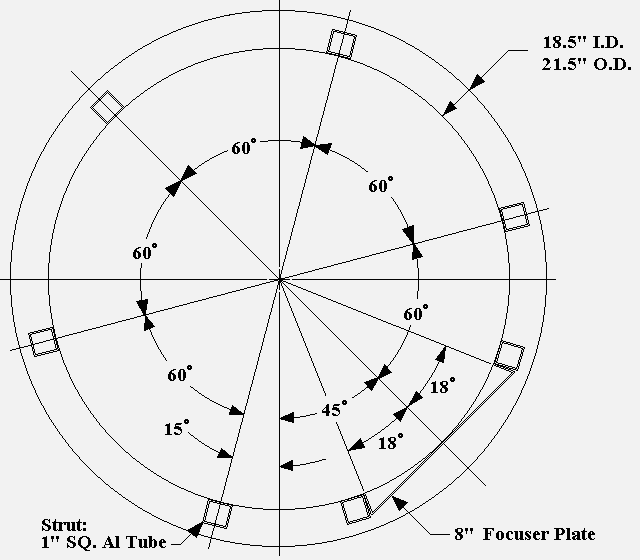
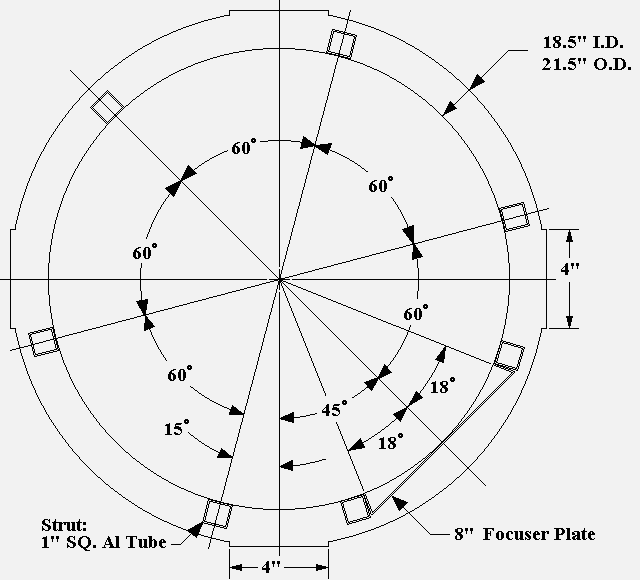
One of the longest-lasting design problems, one that I struggled for weeks with, was how to mount the support struts. I didn't like the designs that I'd seen, and I'd used up pages of paper on ideas. Then the answer literally came to me. An ATM net e-mailing pointed me to a company, Moonlight Telescope Accessories, that has a ball-and-socket connector design. Well, that ended it right there. Plus, they also have a Crayford focuser with the ability to swing a filter in and out of the light path.
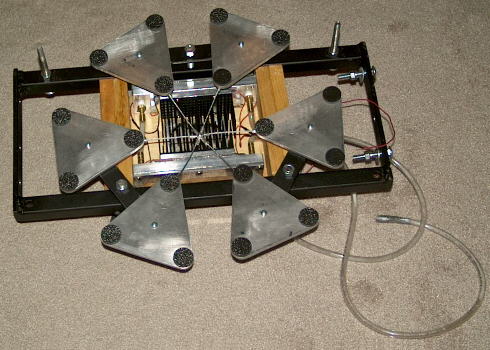
I am working on an idea to minimize dew and heater-induced distortion on the secondary mirror. Due to the peculiarities of thermodynamics, the exposed mirror can cool down faster than the surrounding air- and below the dewpoint. The traditional solution is to use a heater (resistors, heat rope, etc.) of some sort. But now you're distorting the mirror. What I plan to try is using thermoelectric coolers (TEC, for short) to keep the mirror temperature above dewpoint. Sensors monitor the relative humidity, air temperature and mirror temperature, while a controller calculates whether the TEC should heat, cool or stay off.
Digital setting circles of some sort are being considered. One of the other main reasons which killed my interest in the past was light pollution. I grew up in Wyoming, with miles and miles of nothing but open prairie. Not anymore, now living in metro Chicago. It's so hard now to locate fainter stars and constellations. With setting circles, I can compensate for that.
I had planned to build my own controller from scratch. But while doable, it would take an inordinate amount of time. I haven't even got the celestial-to-alt/az coordinates math down yet. Telescope building is not my hobby- looking at the stars is. So, I will buy a pre-programmed system, and all I have to worry about are mounting the encoders. For that, I've been looking at gears to transfer motion.
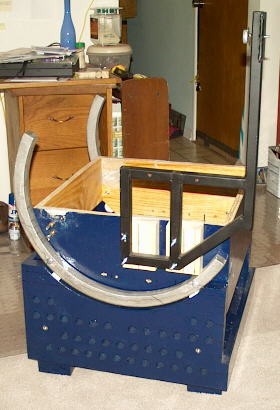
As it turns out, the Stargate-1, so far has turned out significantly over-size and over-weight. If I don't fix this, I will have a telescope too difficult to transport, discouraging its use. That is why I have begun designing a new telescope- the Stargate-2- using much of the original parts. For now, I have come up with both a partial fix for the Stargate-1 and design validation test for the Stargate-2. I will cut the top six inches off the mirror box, making it the same height as the proposed mirror box for the Stargate-2. I need to see if the longer truss tubes will be stable and if having the mirror so close to the side bearing's rotational axis will cause balance problems.