As astonishing as it may seem, with still work to be done on both the Stargate-3 and the mini-Stargate (both all on the electronics), in the aftermath of WOW 2010, I have begun conceptializing yet another telescope design. So, the now-dubbed Stargate-Next Generation (SG-NG) has been conceived, and is intended to be an improvement over the Stargate-3 and mini-Stargate. My goals for the SG-NG are clear, but some are in conflict (but that's always the way it is in engineering). Below are the tentative goals:
1.) Lighter
2.) Taller
3.) Larger aperture than the mini-Stargate
4.) Go-to capability
5.) Mirror temperature functions of the Stargate-3
6.) Improved sensors over the mini-Stargate
Most importantly, the SG-NG will benefit from all of the lessons learned on the Stargate and mini-Stargate. The Stargate-3 was intended from the beginning to be a fully tricked-out scope (temperature controlled mirrors, digital setting circles). But it was plagued by an awfully sharp learning curve. It was first contructed out of wood, but that was unsatisfactory (too big, too heavy). Switching to welded aluminum came with its own learning curve, but at least more satisfying results. However, it still ended up being heavier than I could manage. As a result, I have to remove the mirror to transport it. Which made it harder to implement the primary mirror cooler that I had designed (itself having evolved tremendously). The mini-Stargate was intended to be a no-frills grab-'n'-go scope- something that the Stargate-3 was not. But the mini-Stargate suffered from Creaping Feature Syndrome (CFS). Just take a look at the pictures of the secondary cage! Still, it came far closer to its goals than did the Stargate-3. Now I have a chance to take all that I have learned, and put it into the SG-NG. Ultra-rigid AND lightweight welded aluminum construction. Temperature control of both mirrors using more matured designs. Improved sensor design and electronics- all done even before I switch on the welder. The motor drive and ultra-light construction will be the only real new features.
While the mini-Stargate is certainly more manageable weight-wise compared to its bigger predecessor, there is still much room for improvement. Being lighter would certainly top that list. Hmm, now am I destined to learn how to weld magnesium? Slightly taller would certainly be appreciated; I just feel that it is just too short for comfortable use by me. And I would like a larger mirror. Now, the conflict. I want a more compact and lighter telescope, while also wanting a larger mirror. Besides, what size could I go up to, with weight being a key issue? The mini-Stargate has a 10" mirror. A jump to 12.5", the next size up, gives me the 'So What?' theoretical gain of a half an order of magnitude (see below calculating magnitude limits). For any significant gains in performance, requires significant gains in weight, size and cost (anything much over 16" anyways, well, you may also need to add in the cost of a divorce attorney, too). And to add go-to capability will certainly add weight, as will the primary mirror cooler from the Stargate-3.
"Good artists copy, great artists steal"- Steve Jobs to Bill Gates in "Pirates of Silicon Valley"
I had to start somewhere for ideas, and just like every other design, I scavenged ideas from the Internet. Obsession Telescopes was a natural starting point. As it is, both my telescopes already use Obsession parts. Since I want something lighter, I will likely emulate the Ultra Compact designs. Up to a point. I like the design of my mirror box, rocker and ground board. I may switch from an eight-pole truss to a six-pole truss since the secondary cage will be so much lighter.
I plan on placing most, if not all of the electronics, down on the mirror box- the weight savings there is obvious. I will also implement both of the mirror temperature controls designed for the Stargate-3 in the SG-NG (cooler for the primary, heater for the secondary. That will also limit the choice of mirror size. A larger mirror will require a flotation cell, which makes it harder to mount a temperature sensor. Also, I want to implement go-to capabilities. With go-to capability, the controller will likely be mounted on the rocker. Sensors and GPS will have to be mounted on the secondary. And the main control will be mounted on the mirror box. I don't want the SG-NG to be a rat's nest of wires like the mini-Stargate. Perhaps I will use a wireless link to connect the go-to controller to the main. There will have to be at least one cable to the secondary (power is harder to transmit without wires- Nikola Tesla spent years unsuccessfully trying to make that work), but I would like to depart from RCA-type phono connectors and use instead mini-industrial connectors from Phoenix Contact.
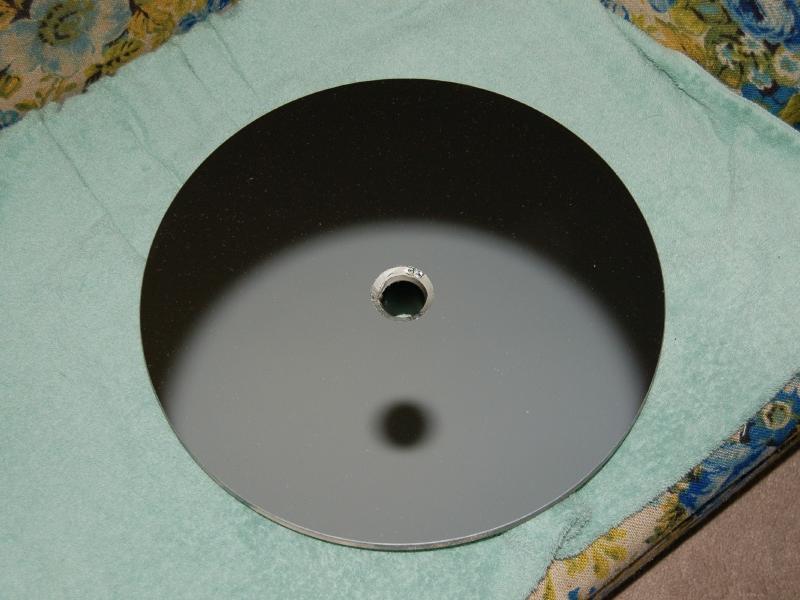
While the debate for me has just begun regarding what size mirror to use, I do not want to use a flotation cell, as with the Stargate-3. But I found an interesting alternative offered by R.F. Royce- a conical mirror. Instead of a flat bottom, the mirror is curved; thinner at the side, thicker in the middle, bolted in place. I'm surprised that this hasn't been thought of before.
In any case, this is still all just conceptual. I need more work on the temperature controls on the Stargate-3 before implementing it on any new design. A go-to design will require that I understand the math behind celestial to alt-az coordinates, in addition to dealing with encoders, stepper motors and gearing. Oh, and most importantly, I need a budget. So, I have time to do the research and perfect the designs. It is possible that the SG-NG will be made from recycling the mini-Stargate. Redesign the mirror box and secondary cage; keep the rocker and ground board unchanged. I guess some things with me never change; starting on a new project before the predecessor is truly finished (In all fairness, what home-built telescope is truly 'finished'?).
Now, for any would-be telescope builder, some advice. I don't claim to be a master, but I am far from a beginner. I've surely made my share of mistakes along the way- especially since I have never followed anyone else's designs exactly. I take designs and ideas that I like, adapt them to my needs and combine with my own ideas. For example, my main design guide is the Berry / Kriege book, The Dobsonian Telescope. But they favor using wood, and all but one of my designs use welded aluminum (Don't think that didn't come without a learning curve!). Anyhow, one mistake that I made was to be obsessed with capturing every last photon. Don't choose the absolutely smallest diagonal mirror. On the Stargate-3, with a 17.5" mirror, ignoring coating losses and diagonal , it has a theoretical magnitude limit of 15.939. I should have gone with a 3.5" diagonal, which reduces the magnitude limit to 15. 895. Instead, I chose a 3.1" diagonal, with a magnitude limit of 15.905. What did I really gain by using the smaller diagonal? The difference between magnitude 15.905 and 15.895 is trivial.
This page was last updated: December 27, 2019
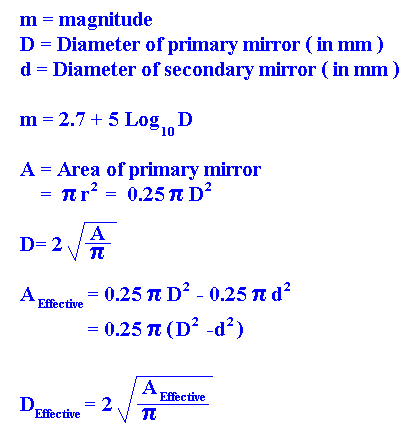
This interest in magnitude limits was sparked at WOW 2010. A fellow ATMer was talking about mirror sizes and how you need to jump the size significantly to noticeable change the telescope's magnitude limit. Naturally, I was curious and scrounged up the above magnitude formula off the Internet. I modified the formula to also account for the secondary mirror (two birds, one stone). Since ultimately it is area of the mirror that determines the magnitude limit, I simply took the area of the primary mirror, substracted the area of the secondary, and calculated the effective diameter. This was plugged back into the magnitude limit formula. Using the 10" mirror of the mini-Stargate as a reference (I am ignoring the secondary for this comparison- it has little impact anyhow), I start with a theoretical magnitude of 14.7. To jump one order of magnitude, the next mirror size up would be 16 inches. Then 25 inches and 40 inches respectively.
Basic Design
I received a quick reply from R.F. Royce for basic specifications on their conical mirrors. Since weight is the most crucial design factor, it is clear that the SG-NG will be limited to 12.5" maximum and a theoretical magnitude limit of 15.1 (with the secondary mirror factored in). The 14.5" (20 pounds) and 16" mirrors (25 pounds) weigh by themselves almost as much as the entire mirror box assembly of the mini-Stargate. At least, though, I won't be dealing with a telescope any larger (wider) than the mini-Stargate. I have no desire to design and build a mirror cell for the SG-NG, so I will go with a commercially available one suggested by R.F. Royce, made by Compact Precision Telescopes. I am still waiting on CPT for dimensional information on the mirror cell. While the knock-your-socks-off 3D model is helpful, I need hard numbers to make sure where I can place the cell supports. Also, I need to know what kind of space I have to work with for the primary mirror cooler.
I had hoped to be able to recycle the rocker and ground board from the mini-Stargate, but to do so will make it hard to get the new mirror in. I am now debating whether or not to go to a 14.5" SQ or 15" SQ design. As it stands, the shortened 14" SQ design may not leave me enough room to mount the main electronics and battery boxes.
It's official now, the design will employ a 15" SQ mirror box. I still don't have a hard design yet for the mirror coolers and CPT has not yet replied to my request for specifications. I have also worked on the controllers for the SG-NG. To say the least, for all of the functions, I was a little taken aback at how many I/O lines I will need to make it all work. While there is plenty of leg room in the mirror box controller, the secondary ring controller will surely be a tight fit. Since I have settled on the basic size of the SG-NG, a review of the specifications:
1.) A rich field view telescope
2.) Lightweight, compact and fast to set up
3.) Dobsonian telescope with truss-tube construction
4.) 12.5" - f/5 conical mirror
5.) 2.6" secondary mirror
6.) Crayford focuser with swing filter option
7.) Temperature control of both the primary (cooling) and secondary (heating) mirror
8.) 15" SQ mirror box and single-ring secondary assembly
9.) 7x50 finderscope, green laser pointer, sighting tube
10.) Welded aluminum frame, cast aluminum side bearings
November 10, 2011
It had been dead and buried for nearly a year. But like zombies and tax hike proposals, the 14.5" mirror won't stay dead. It may be better this way, in the long run. A 12.5" mirror won't give enough of a performance boost (compared to the 10" mini-Stargate), inviting yet another telescope project. So, my design efforts now will be focused on a 14.5" / f5 mirror.
February 22, 2012
Most of the design work is still under way. The mirror box is nearly done. I just finalized the mirror cell design, which helps out with the mirror box design. Not much to do with the rocker and ground board, other than to scale down the existing design. The secondary cage is nearly done. I still wanted to use the classic design, as opposed to the ultralight design. I started a weight analysis of both designs, and saw that it was no contest. I simply can't afford two plus pounds extra for the classic design. I still have many ideas on the table for the primary mirror active cooler, so no contender there yet.
February 19, 2013
I finally got the 14.5" f/5 conical mirror from Royce.
October 24, 2013
I am nearly done with the electronic design work- mostly with Samantha. Ideas are plentiful, and keep coming. Most notable are for the shadow fan, which I can feed up through the hole in the mirror (scrapped on the SG-3 because of the necessity of taking out the mirror during transport), and the idea of varying the voltage (and, subsequently, the power) to the TECs in the mirror cooler.
January 24, 2015
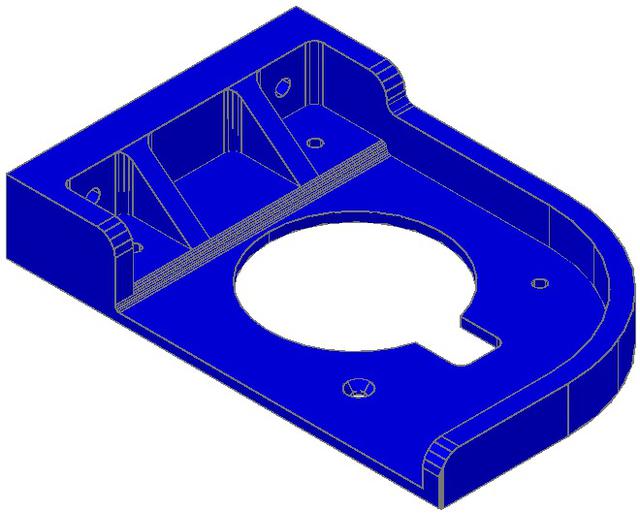
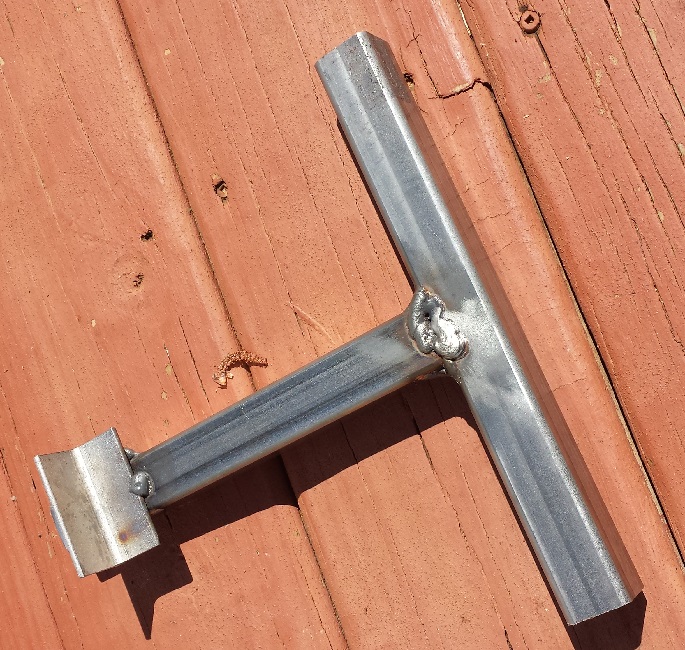
Because of circumstances, I have not been able to work on this project for quite a while. But, with last months' break, I was able to finish the mirror box (excluding electronics). I finally killed the idea of a cooled mirror (haven't I said that before?). The mirror box is painted, the mirror has been mounted- hopefully permanently. The temperature sensor has been glued to the mirror (in the bore area) and the shadow and box fans are installed. I'm still working on electronics. The hydrogen line receiver (H2RX) has gotten a big push; I have parts to build a complete prototype. If it tests well with the sun, I will expand its gain. And that's where another problem of mine creeps in- good is never good enough. The basic H2RX includes a LNA (50 mA) and power detector (100 mA). Add to that, up to 6 MAR-6 stages (6 x 16 mA = 96 mA). All of this from battery power. I finished up the battery boxes with the thought that maybe I should consider SLA batteries instead of alkaline / NiMH. We'll see when I commit prototypes to the final project. I also redesigned the focuser bracket. I modelled it in AutoCAD (see below), and will soon have access to both MasterCAM and a CNC shop (if I get permission).
I am ready to test the telescope, but now am at the mercy of the weather. I made a set of adjustable truss poles, but they are more wobbly than I would like. I don't know what the exact focal length is, and didn't want to cut file and drill eight poles times however many times needed. I never got any mirror specs from Royce, and had enough of a hassle in just getting the mirror, I will feel much better after I have proven the mirror. In the mean time, interestingly, the poles for the SG-3 are only about six inches longer than what I would expect for an f/5 mirror. I can adjust the mirror indoors now, and wait for warmer weather and clear skies. And, I hope I got a true f/5, and not a shut-up-and-go-away mirror.
June 12, 2015
First Light for the SG-NG! While most of the time at WOW 2015 it was raining or overcast, I did get one night good enough to view. From that, I confirmed that the mirror is approximately an f/4.8. I can now dispose of those horrid temporary poles and make permanent ones. But I still need another test, and the weather does not want to cooperate.
June 17, 2015
With forward motion again on the project, I began a review of the electronics needed. I finally dropped a number of the "sweeteners" (haze detector, dew/rain sensor, static charge detector). With that, I can finally go ahead and start prototyping.
October 15, 2016
IDSSP 2016 was a rain-out. But the experience of preparing for it sparked new energy for the SG-NG. I realized that if my physical ability dropped, I might not be able to use this telescope. After all, that was what happened to the now-gathering-dust SG-3. So, I have given thought on what I can do to improve the SG-NG.
First and foremost, fix the height. I made the mirror box short to keep it light. But I did not expect the mirror to be practically touching the box cover! That's the problem of a one-man design team- no oversight. Adding an inch to the height and eliminating the socket spacers is very doable. I had thought to shrink the box inwards using narrower tubing. But no, I saw that the deciding parameter for mirror box size is more the secondary ring than the mirror. I should be able to reduce the weight, as I tend to over-engineering my designs. I hope to be able to reduce the mirror box 3 to 5 pounds, and so far, I'm close. I will, though, have to focus on keeping the key areas strong- ring and mirror cell supports, and the counterbalance mount.
Another problem is with the rocker. I noticed that it was too easy to tip it. But the rocker for the mini-Stargate was stable. Then I saw the problem: the rocker for the mini-Stargate is square while it is rectangular for the SG-NG; the base radius is determined by the shortest side. To fix that, I will need to fabricate a new base and to either modify the existing rocker by extending the area out 1.5 inches or rebuild from scratch.
This brainstorming is just the beginning, but it looks like I have some good ideas (plus a healthy dose of hindsight!) to build the SG-NG-2. And I don't have as much to build. I can reuse the secondary and mirror cell without any modification.
November 26, 2016
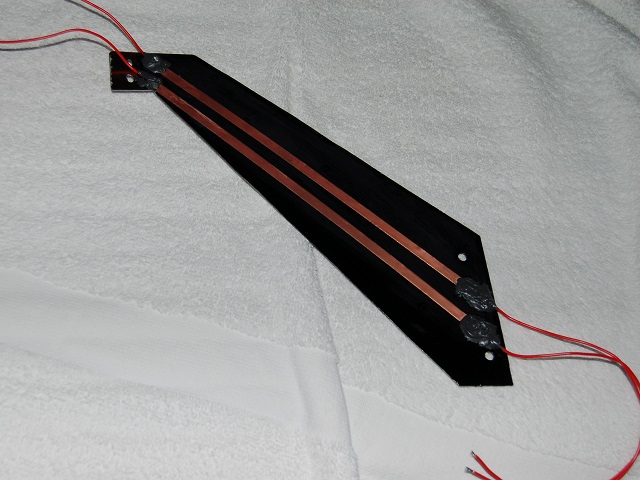
I have finished redesigning the mirror box, and I calculate that I have eliminated 2 pounds. There's really not anything more than I can do there. I have nearly finished redesigning the ground board. It was a big help having access to AutoCAD for this. As for the rocker, unless there is a reason not to use it (e.g., it not being square), I will modify it, rather than rebuild. On a totally different problem, I think that I finally have a solution for the dew heater. How do I get power to the secondary mirror without obstructing the light path? Copper tape would make a good carrier; it is very thin and has the current-carrying capacity. But the spider vanes are metal. I finally realized that magnet wire is coated with a very thin layer of paint, and it works well. I painted one vane with black enamel,. I cut and taped two copper strips to a ceramic plate (so I could solder #22 wires to them). After the paint was thoroughly dry, I used super glue to adhere two strips to the vane. I dabbed JB Weld onto the soldered ends for strain relief. When this was all cured, I painted it all over. Now, how well will this handle the stress of field service? The vanes can flex. Will the paint handle the summer sun without separating?
December 31, 2016
I have just finished redesigning the ground board and rocker, and tweaked the mirror box design. I also made drawings in AutoCAD of the mirror box. I'm just a little peeved at myself for having done such a sloppy job of archiving the previous design. I ended up having to reverse engineer my own project! With this vastly better documentation, I also hope to avoid errors in fabrication- like what happened before with the mirror box. Also, I did not want to redesign, let alone refabricate, the rocker, but I just couldn't see how I could save something that flawed. Hopefully, I can also improve the fabrication process there too. It's a cliche, but it is true: Hindsight really IS 20/20. Construction is tentatively set for late March or early April 2017. As for the secondary ring, it's all painted and nearly fully reassembled. Now for the controls...
June 2, 2018
I finished new mirror box and rocker. I made the box an inch deeper without needing to shorten the truss poles.
October 6, 2018
IDSSP 2018 drove home the point that the new mirror box was not an improvement in the weight department. I also noticed how heavy the mirror cell was. I decided that it would be wise to examine if I can make both the mirror box and cell lighter.
April 26, 2019
After another marathon welding session, I finished both the third version of the mirror box and a new mirror cell. My best guess is that I have cut out 5 to 8 pounds. Now to drill and tap a whole 'lot a holes!
September 28, 2019
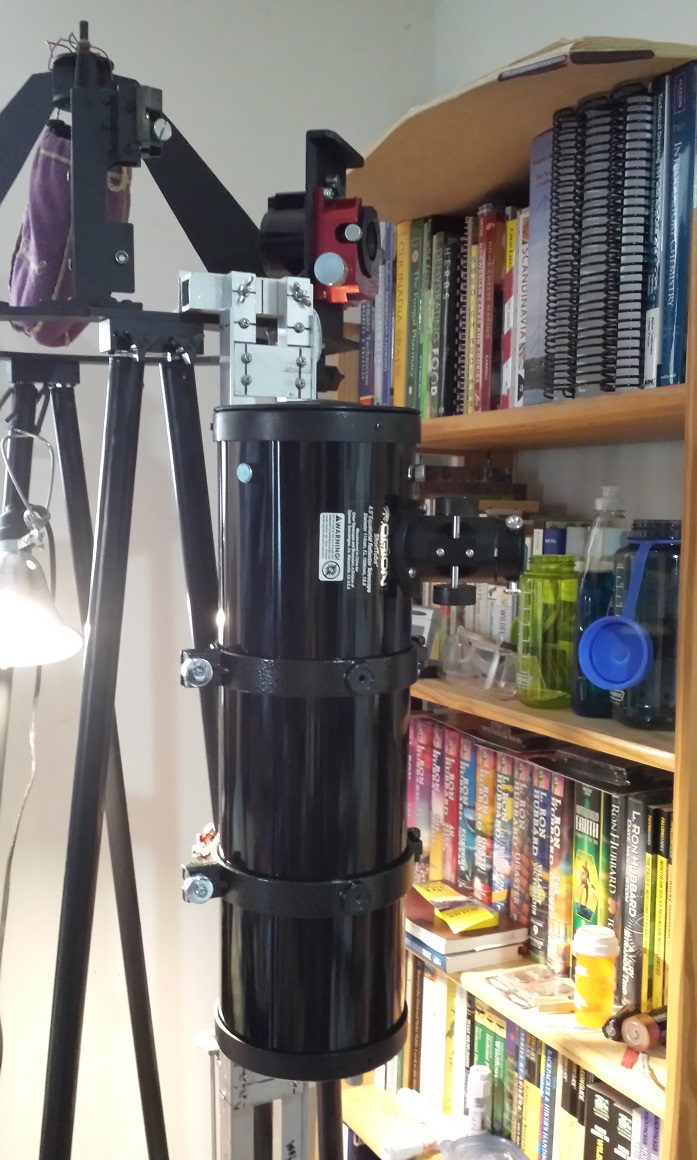
Following a presentation on telescopes at IDSSP 2019, I wondered if I could find a way to mount a 4.5" reflector that I'd bought to use on the SG-3. Richard Berry's book, Build Your Own Telescope, recommended a finder scope of 1/4 to 1/3 the diameter of the aperture, so this one is ideal. I get nearly a two magnitude limit improvement over my 50mm finder. Plus, I may now be able to use filters- such as a sky glow filter- to make it easier to find various objects. And I have a number of starter telescope Plössl eyepieces. So if I need a different filter, it's easier to swap the eyepiece, rather than the filter (at night!). I bought a better Plössl eyepiece, with the widest field of view that I could find for general use. I came up with the idea of a removable bracket holding the tube mount rings that will bolt to the mirror box and secondary ring. It took weeks to design and make something that was both stable and able to be broken down for transport.
I also came up with an idea to make a sight tube as a fast alignment tool. Simply mount an aluminum tube of sufficient length in a laser pointer mount. It may need an additional mount to move it away from the 4.5" reflector. Both still need to be tested and aligned.
December 16, 2019
I tested a new beacon circuit, and it works reliably.

 As astonishing as it may seem, with still work to be done on both the Stargate-3 and the mini-Stargate (both all on the electronics), in the aftermath of WOW 2010, I have begun conceptializing yet another telescope design. So, the now-dubbed Stargate-Next Generation (SG-NG) has been conceived, and is intended to be an improvement over the Stargate-3 and mini-Stargate. My goals for the SG-NG are clear, but some are in conflict (but that's always the way it is in engineering). Below are the tentative goals: