




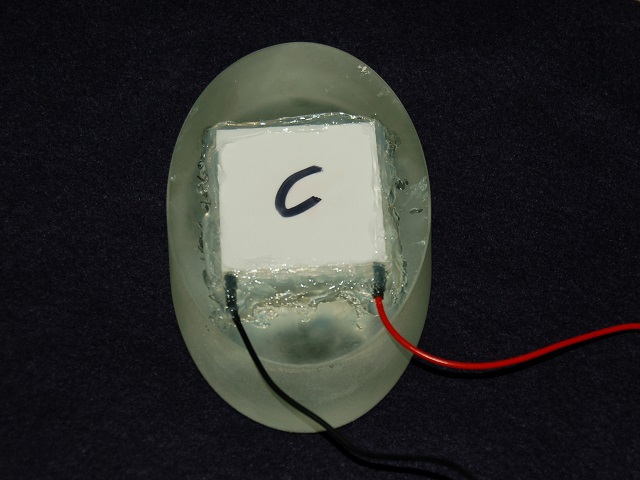
 Actively controlling the mirror temperatures has been a signature concept since the conception of the Stargate-1. With the primary mirror, cooling is the possible need. If the mirror is warmer than the air, turbulence is possible that will degrade viewing. Such a large mass of glass holds heat and cools more slowly than the ambient air, and in certain environments where there are significant temperature swings from day to night (such as a high-altitude site), something more than a fan may be needed. The opposite is the case with the secondary mirror. Facing a much cooler sky, it tends to cool below ambient air temperature. If it cools below the dew point, then moisture can condensate on the mirror. Here, gentle heating is needed. Since this telescope is to be a premium telescope, both primary and secondary temperature controls will likely end up in the final design.In thinking about the primary cooler, I am considering an old idea- using liquid cooling for the thermoelectric modules. If I can find suitable quick-disconnects for liquid, and replace water with RV antifreeze, it may work. I won't consider water again, as it caused corrosion of the heatsinks. The heatsinks themselves may work in standalone mode, having enough metal to draw away heat.The ideas for liquid cooling just keep rolling in. One possibility is a closed-loop design with a fan blowing air across a coil of copper tube carrying coolant to and from the modules. Or the coiled tube could be placed in a section of PCV pipe capped at either end. Water or antifreeze, external to the telescope, could be circulated through the PVC section from a second pump- all very much like the Cookbook camera design. Not too bad for an idea that I deemed dead years ago.I am probably going to drop putting a temperature sensor on the secondary mirror. How can I get accurate readings if the sensor is next to the heat source? I had largely avoided this issue, as I had not yet implemented heat for the secondary mirror. Now, putting a sensor on the ring- like with the mini-Stargate- makes more sense (no pun intended). I probably do not need such precise control with the heat source now, either. Simply turn on heat when the temperature approaches dewpoint.I have dropped (again!) the idea of active mirror cooling. It comes with too many problems- weight, complexity and battery demands. Especially the latter; I already have plenty of demand on the battery.I am currently working on mounting a type E thermocouple on the ring. Will the analog and A/D electronics be part of Samantha? Or another standalone box? Also, I think that the sky temperature sensor can help with control of the secondary mirror temperature. It can predict how fast and how far both the secondary mirror and laser will cool. I will have to review blackbody physics for calculations.I was considering a thermistor over a thermocouple for the ring. But between all of the don'ts that came on the datasheet, and that I expect a wider range of temperatures than spec'd, I will stay with the thermocouple. Also, while I do not currently have an active design for a primary mirror cooler, I will include the power electronics in Hammond for a possible experimental cooler (most likely an air cooled design). Not dead yet!The design for Hammond is all but done. I have reserved enough hardware to handle any primary mirror cooling system, whether it be liquid or air cooled. Also, one idea under development is to control voltage to the TEC modules. Boost the voltage initially to accelerate cooling, then dial it down to lessen Joule heating. Running a TEC at full power is less efficient; Joule heating could overwhelm the heat dissipation mechanisms and defeat the purpose of cooling the mirror.With the problem of getting power to the secondary mirror apparently solved, I can move forward with the dew heater. I used RTV silicone to glue a TEC to the back of the mirror (with silicone heat sink compound). Why use a TEC for heat? Aren't those used for cooling? First, cold cannot be created. All a TEC does is create a temperature differential. And it uses a lot of energy in doing so, producing a lot of waste heat. In this case, the waste heat is what is wanted. Others have used resistors or a tangle of insulated nichrome wire. But the TEC is very flat and provides a large area of contact to the mirror- possibly allowing me to use less power than with the other approaches (i.e., I'm only heating the mirror, and nothing else). I'm still experimenting with power, but a 40mm square TEC operating at 2V should provide enough heat. I will have to make an experiment, though. Glue a TEC to the bottom of a small metal box, filled with a known amout of water. Then, measure the temperature change of the water per unit of time to calculate energy transfered. Then it's a simple matter to determine how much energy will change the mirror's temperature.There is another issue to deal with here- power. I had previously used DC-DC converters before to maximize efficiency. Look at the laser pointer- it uses nearly 200mA at 3V. But the bus power is 6V. Using a linear regulator, I'm wasting half of the power in a system using batteries. But I had problems with the converters that I used- including draining the battery when idling. So, since the laser pointer has such a low duty cycle (only on for a very short time), linear regulator inefficiency was an acceptable trade for simplicity and reliability. But the dew heater won't work like that. It will be on and stay on as long as the mirror is near the dew point temperature, I think I have a more suitable buck converter, but will have to test it.
 I just finished a dew point algorithm using only multiplication, division, addition and subtraction. Since I have killed (once again) the go-to functions (I will never get them done with all that I have going on), I no longer have a need to worry about messy celestial coordinate calculations. And I no longer need the FPU, freeing up two I/O lines and some board space. Except for solving for dew point. But now I can solve for dew point with only basic math and eliminate the need for the FPU. It still needs to be adapted to the integer math of the BASIC Stamp, but I don't see any real trouble there. The sole purpose is to determine when to turn on the dew heater, and I have enough precision in my algorithm.